
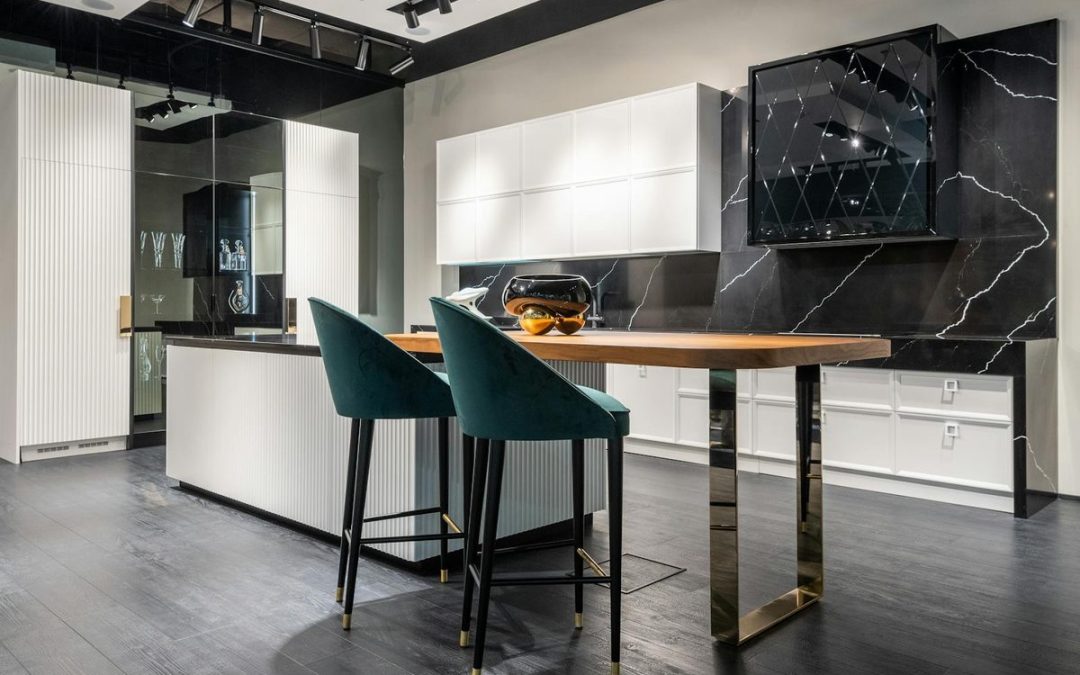
Few finishes command a room the way a true high gloss lacquer finish does. On cabinetry, a paneled door, or a statement ceiling, that deep, liquid sheen reads as quiet luxury long before anyone identifies why. It also happens to be the least forgiving finish in the trade. Where a matte wall conceals minor flaws, a mirror-like surface broadcasts every one of them. At Jerome Russo’s Quality Painting & Decorating, we have refined high-gloss and lacquer work across South Florida’s finest homes since 1976, and the difference between a flawless result and an ordinary one comes down almost entirely to discipline.
Why a High Gloss Lacquer Finish Is So Unforgiving
Gloss is, in effect, a magnifying glass. The smoother and more reflective the surface, the more light it returns to the eye in a clean, undistorted way. Any deviation from perfectly flat, an underlying ridge, a sanding scratch, a speck of dust, a slight wave in the substrate, interrupts that reflection and becomes immediately visible. A flat or eggshell paint scatters light and forgives a great deal. A high-gloss or lacquer coating reflects light and forgives almost nothing.
This is why the finish itself is only a fraction of the work. The vast majority of the effort happens before the final coats are ever applied. What you are ultimately seeing in a beautiful gloss finish is not paint so much as preparation.
The Obsessive Surface Preparation Behind a High Gloss Lacquer Finish
Achieving a glass-smooth substrate is methodical, unglamorous, and absolutely essential. The goal is a surface so true that the coating has nothing to reveal but its own depth. Our preparation typically involves:
- Assessment and repair. Every dent, grain line, nail hole, and seam is identified. On older millwork and restoration projects, we address failing finishes and previous repairs that would otherwise telegraph through.
- Filling and leveling. Imperfections are filled, then filled again as needed, building a uniform plane rather than simply patching low spots.
- Progressive sanding. Surfaces are sanded through increasingly fine grits so each pass removes the scratches left by the last. This is the step most often rushed and most often regretted.
- Priming to a true substrate. High-build primers are applied and sanded back to create a sealed, dead-flat foundation. The primer stage is where the finish is truly won; a coating is only as smooth as what sits beneath it.
Only when the primed surface is uniform, sealed, and glass-smooth do we consider it ready for color and gloss.
Dust and Environment Control
On a high-gloss surface, a single airborne particle that lands in a wet coat becomes a permanent blemish. Controlling the environment is therefore part of the craft, not an afterthought. We manage dust, airflow, and cleanliness in the work area, tack surfaces meticulously between coats, and pay close attention to temperature and humidity, which in our coastal climate directly affect how a coating flows and cures. A patient, controlled environment is what allows a finish to level out smooth and dry clean.
Multiple Thin Coats, With Sanding Between
A deep gloss is built, not poured. Rather than one heavy application, we lay down multiple thin, even coats. Thin coats flow out more uniformly, resist sagging and runs, and cure more predictably. Between coats, surfaces are sanded again to remove any minor imperfection and to give the next coat a uniform surface to bond to. Each cycle adds depth and refinement, and the final coats are where the mirror-like clarity emerges. It is a slow, deliberate rhythm, and there is no shortcut that survives the scrutiny of the finished surface.
Spray Application Versus Brushing
For the highest-clarity work, fine spray application is the method of choice. A properly tuned spray system atomizes the coating into a fine, even film that levels into a seamless surface with no brush marks. Achieving that result demands skill, the right equipment, careful masking, and a controlled space, which is precisely why it belongs in experienced hands.
Brushing and rolling still have their place; a skilled hand can lay off a refined finish on certain surfaces and details. But for cabinetry, doors, and millwork where flawless gloss is the goal, spray application consistently delivers the cleanest, most uniform result.
Where a High-Gloss or Lacquer Finish Belongs
This level of finish is best reserved for surfaces meant to be admired and touched. It rewards the eye most on:
- Custom cabinetry and built-ins
- Interior and entry doors
- Millwork, trim, and paneling
- Statement ceilings, where a reflective finish adds depth and light to a room
- Fine furniture-grade and decorative elements
On the right surface, a high-gloss or lacquer finish elevates the entire space. On the wrong one, or executed without care, it simply highlights flaws. Knowing where, and how, to apply it is part of the expertise.
The Craftsmanship and Patience That Set It Apart
What separates a true high-gloss finish from ordinary paint is not a single product or trick. It is the accumulation of dozens of patient decisions: how thoroughly the surface was leveled, how cleanly the space was kept, how many coats were laid and how finely sanded between them, and the restraint to let each stage cure properly before moving on. That patience is the craft, and it is what gives a finish its lasting depth and integrity.
If you are considering a high-gloss or lacquer finish for your cabinetry, doors, millwork, or ceilings, we would welcome the opportunity to discuss it. To request a consultation with Jerome Russo’s Quality Painting & Decorating, or simply to ask a question, call us at (561) 585-7506.
Bring This Level of Craft to Your Home
From a single signature room to an entire estate, Jerome Russo’s delivers finishes worthy of South Florida’s finest homes since 1976.
Request a Consultation